
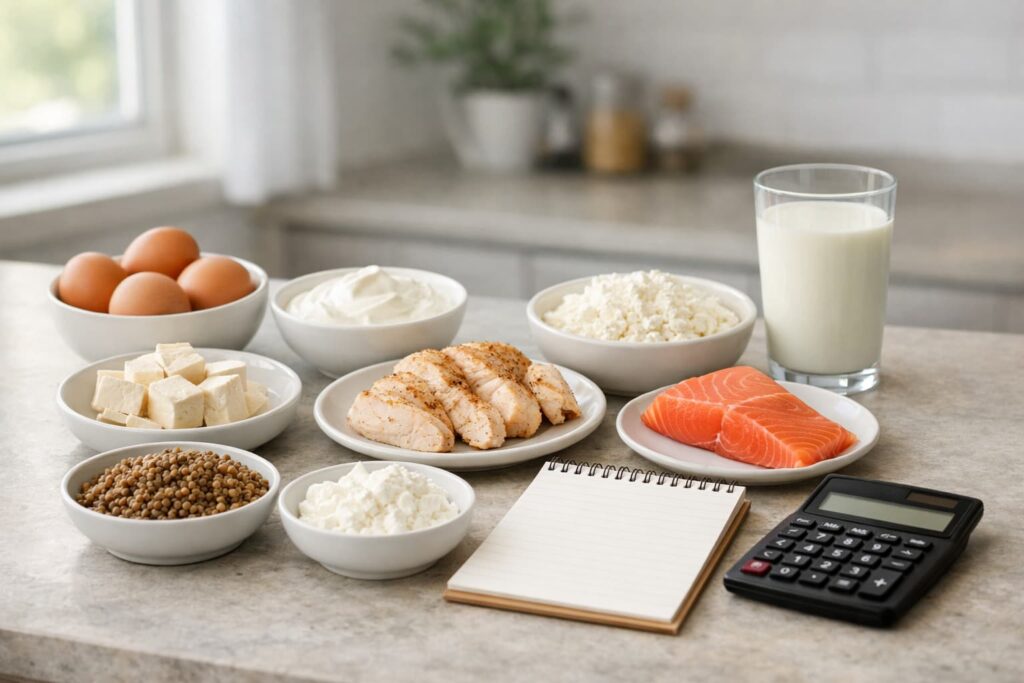
Most healthy adults trying to build muscle should aim for about 1.4 to 2.0 grams of protein per kilogram of body weight per day, with around 1.6 g/kg/day being a strong evidence-based target for many people who do resistance training. The exact amount depends on your body weight, training, calorie intake, age, and whether you are trying to gain, maintain, or cut body fat.
Understanding how much protein to eat matters because the standard adult recommendation is designed to prevent deficiency, not to maximize muscle growth. NIH Office of Dietary Supplements explains that general nutrient recommendations are meant to support overall adequacy, while people who train regularly often need a more deliberate approach to support recovery and muscle growth. Hitting the right daily target, spreading protein across meals, and pairing it with progressive strength training can make your muscle-building plan more effective and easier to follow.
How much protein should I eat to build muscle each day?
A practical target for muscle gain is 1.6 grams of protein per kilogram of body weight per day. That number sits right in the middle of the 1.4 to 2.0 g/kg/day range supported by the International Society of Sports Nutrition. A major meta-analysis published in the British Journal of Sports Medicine also found that going above about 1.6 g/kg/day did not clearly add more muscle-building benefit for most people in the available resistance-training studies.
That said, there is no single perfect number for everyone. Some people do well near the lower end of the range, while others may benefit from the upper end, especially if they are lean, training hard, older, or eating in a calorie deficit while trying to keep muscle. The same International Society of Sports Nutrition position stand notes that protein needs can rise during dieting phases, sometimes into a higher range, to help retain lean mass.
Protein intake for muscle gain at a glance
Here is a simple way to think about daily intake:
- Good starting point: 1.4 g/kg/day
- Strong evidence-based target: 1.6 g/kg/day
- Common upper practical range: 2.0 to 2.2 g/kg/day in some cases
- During calorie restriction: sometimes higher, depending on training status and leanness
If you prefer pounds, divide your body weight in pounds by 2.2 to get kilograms, then multiply by your protein target.
How to calculate how much protein you need to build muscle
Use this formula:
Body weight in kilograms × protein target = grams of protein per day
Examples based on 1.6 g/kg/day:
| Body Weight | Daily Protein Target |
|---|---|
| 60 kg | 96 g |
| 70 kg | 112 g |
| 80 kg | 128 g |
| 90 kg | 144 g |
These examples are practical estimates based on the intake level most often highlighted in the research on protein and resistance training.
If you track in pounds, here are quick examples:
| Body Weight | Approximate Daily Protein at 1.6 g/kg |
|---|---|
| 132 lb | 96 g |
| 154 lb | 112 g |
| 176 lb | 128 g |
| 198 lb | 144 g |
Is the RDA enough to build muscle?
Usually, no. The NIH Office of Dietary Supplements explains that the Recommended Dietary Allowance is the average daily intake level sufficient to meet the nutrient needs of nearly all healthy people. That is a general adequacy target, not a muscle-gain target. For people lifting weights regularly, the evidence points to higher protein needs than the basic adult minimum.
This is why someone can technically meet minimum nutrition needs and still fall short of the intake that best supports muscle protein synthesis, recovery, and lean-mass gains from training.
Does eating more protein build more muscle?
Not automatically. More protein helps only up to a point. The research shows that raising total daily protein from low or moderate levels to an evidence-based target can improve gains in lean mass and strength during resistance training. But once intake is already high enough, adding more does not guarantee extra muscle.
For many people, the bigger mistake is not eating too little at breakfast and lunch, missing total daily intake, or expecting protein powder to compensate for inconsistent training, poor sleep, or too few calories. Muscle is built by training plus recovery, with protein supporting that process.
How much protein per meal is best for muscle growth?
Daily total matters most, but meal distribution still helps. The International Society of Sports Nutrition notes that a practical per-meal target is about 0.25 g/kg, or roughly 20 to 40 grams of high-quality protein per meal, spread every 3 to 4 hours across the day.
For many adults, that means something like this:
- Breakfast: 25 to 35 g
- Lunch: 25 to 40 g
- Post-workout or snack: 20 to 30 g
- Dinner: 25 to 40 g
This approach is often more useful than eating very little protein all day and trying to make up for it with one huge dinner.
Should you eat protein before or after a workout?
You do not need to obsess over a tiny anabolic window. The best-supported advice is to hit your total daily protein goal and place a protein-rich meal or snack reasonably close to training when convenient. Protein before or after lifting can both work.
A simple plan is to have a meal containing 20 to 40 grams of protein within a few hours before training or after training, depending on your schedule. The total amount you eat during the day still matters more than perfect timing.
Best protein foods to build muscle
According to USDA MyPlate, protein foods include seafood, meat, poultry, eggs, beans, peas, lentils, nuts, seeds, and soy products. Dairy foods such as Greek yogurt, cottage cheese, and milk can also be useful in muscle-building diets because they provide high-quality protein and are easy to include in meals and snacks.
Good practical options include:
- Chicken, turkey, lean beef, fish, shrimp
- Eggs and egg whites
- Greek yogurt, cottage cheese, milk
- Tofu, tempeh, edamame
- Lentils, beans, peas
- Protein powders when whole foods are not convenient
Whole foods should usually do most of the work. Protein powder is helpful for convenience, not because it is inherently better than food.
Do you need protein powder to build muscle?
No. You can build muscle with whole foods alone if you consistently meet your daily protein target and train hard enough. Protein powder is mainly a convenient way to fill gaps, especially if you have a busy schedule, poor appetite after training, or trouble reaching your goal with regular meals.
For example, if your target is 128 grams per day and your normal meals get you to 100 grams, a shake that adds 20 to 30 grams can make your plan easier. But it is still the total intake and training stimulus that matter most.
How much protein should women eat to build muscle?
The basic formula is the same for women and men. Protein targets for muscle gain are usually based on body weight, training, and goals, not sex alone. A woman who weighs 60 kg and lifts regularly may aim for about 96 grams per day at 1.6 g/kg, while a woman at 70 kg may aim for about 112 grams per day.
Women sometimes underestimate protein needs because many meal patterns are lower in protein at breakfast and snacks. In practice, evenly distributing protein across the day often helps more than making dinner larger.
How much protein should older adults eat to build muscle?
Older adults may benefit from being more intentional about protein intake because muscle protein synthesis becomes less responsive with age. That does not mean extreme intakes are always necessary, but it does mean that older adults doing strength training often benefit from staying toward the stronger end of evidence-based sport-nutrition ranges and from getting enough protein at each meal.
A realistic starting point for many older adults lifting weights is still around 1.4 to 1.6 g/kg/day, then adjusting based on appetite, progress, total calorie intake, and medical guidance if needed.
What if you are trying to build muscle while losing fat?
This is one of the situations where protein matters even more. The International Society of Sports Nutrition notes that when calories are reduced, higher protein intake can help preserve lean mass during training. Resistance-trained people in calorie deficits may need protein above the usual muscle-gain baseline to better retain muscle.
That does not mean everyone cutting should eat the maximum possible amount. It means your protein target should usually be more deliberate when you are trying to get leaner without sacrificing strength and muscle.
Common mistakes that make protein goals harder to reach
Eating too little protein early in the day
A very low-protein breakfast can make it hard to reach your target without forcing a huge dinner. Aim to start the day with a real protein source such as eggs, Greek yogurt, cottage cheese, milk, tofu, or a protein smoothie.
Focusing on supplements more than meals
Supplements can help, but they cannot replace a well-built eating pattern. Regular meals with protein-rich foods are usually the easiest way to stay consistent. USDA MyPlate supports building meals around a variety of protein foods rather than relying on a single source.
Ignoring total calories
Protein supports muscle gain, but muscle is still harder to build if your overall calorie intake is too low for your goal. In many cases, a small calorie surplus plus consistent resistance training works better than simply adding more protein to an otherwise inadequate diet.
Not training with enough resistance
Protein alone does not build much muscle. The training stimulus is what tells your body to use amino acids for repair and growth. Without progressive overload, extra protein has limited value for hypertrophy.
A simple one-day high-protein example
Here is a practical example for someone targeting about 120 to 130 grams per day:
| Meal | Example | Approx. Protein |
|---|---|---|
| Breakfast | Greek yogurt, oats, berries, chia | 25–30 g |
| Lunch | Chicken, rice, vegetables | 35–40 g |
| Snack | Milk or protein shake and fruit | 20–30 g |
| Dinner | Salmon, potatoes, vegetables | 30–35 g |
The exact foods can vary. The key is that each meal contributes meaningful protein so the daily total becomes easier to hit.
Who should be careful with high-protein diets?
For most healthy adults, higher-protein diets within common sport-nutrition ranges are generally acceptable. But people with chronic kidney disease should not copy muscle-building protein targets without medical guidance. The National Institute of Diabetes and Digestive and Kidney Diseases notes that some people with CKD may need to consume moderate amounts of protein so waste does not build up in the blood.
The National Kidney Foundation also advises that protein needs in CKD depend on whether someone is on dialysis and that individualized guidance matters. If you have kidney disease or another medical condition that affects diet, discuss your target with a clinician or renal dietitian.
How much protein should I eat to build muscle: the bottom line
If you want one clear number, start with 1.6 grams of protein per kilogram of body weight per day. That is the most useful evidence-based benchmark for many adults doing resistance training. Then spread that intake across 3 to 5 meals or snacks, aim for 20 to 40 grams per meal, and keep training consistently.
You do not need perfect timing, expensive supplements, or extremely high intakes. You need enough protein, enough training, and enough consistency to let the process work.
FAQs
Is 100 grams of protein a day enough to build muscle?
It depends on your body weight. For someone who weighs about 62.5 kg, 100 grams per day equals roughly 1.6 g/kg/day, which is a strong target. For someone much heavier, it may be too low for optimal muscle gain.
Is 200 grams of protein too much?
It depends on your size and goal. For a 100 kg person, 200 grams equals 2.0 g/kg/day, which can still sit inside common sport-nutrition ranges. For a much smaller person, it may be more than needed and may not provide extra muscle-building benefit.
Can I build muscle on a vegetarian diet?
Yes. Beans, lentils, soy foods, dairy, eggs, nuts, and seeds can all contribute to your protein goal. USDA MyPlate includes beans, peas, lentils, nuts, seeds, and soy products in the protein foods group.
Is whey protein better than food?
Not inherently. Whey is convenient and high quality, but it is not required. Whole foods can work just as well when total daily protein and meal distribution are adequate.
Do I need protein right after my workout?
Not necessarily right away. A protein-rich meal or snack near training is useful, but your total daily intake matters more than chasing an exact minute-by-minute window.
How long does it take to see results from eating more protein?
Protein helps only when it supports a consistent training program. Changes in strength can happen sooner, while visible muscle gain usually takes longer and depends on training quality, calories, recovery, and your starting point. Protein is one part of the overall muscle-building process, not a standalone shortcut.
Conclusion
Building muscle does not require extreme protein intake, but it does require enough. For most people, 1.6 g/kg/day is the smartest place to start. Build your meals around real protein foods, spread intake across the day, train with progressive resistance, and adjust based on your body weight, performance, and results. That simple approach is usually more effective than overcomplicating the process.
Safety disclaimer: This content is for informational purposes only and not medical advice.